Showing posts with label Inquiry learning. Show all posts

Sunday, 13 December 2015

Interest Projects - All Wrapped Up For Christmas

It has been so satisfying for many of us sharing our term four interest projects.

One way we ensure that we are taking ownership, accountability and responsibility for our learning in Room 14 is through the sharing routines we have. During our first I.P. this year, sharing in front of the class seemed a little daunting for some. However, the encouragement shown for each other and the ability to give constructive feedback has grown to such a level that sharing interest projects is a positive experience and a time for celebration. The conversation arising after the sharing of an interest project is genuinely exciting as students often realise that they are the most knowledgeable person in the room about their chosen topic, which can be so empowering when answering questions from their peers.

Those who initially found driving their own projects a challenge have made great progress. Being handed more responsibility and knowing that the teacher is only assisting as a guide was something to get their heads around at first. Of course, there are still things that all of us could have improved on this time, but our skills and attitudes for self-driven inquiry projects have grown a lot as a class.

We had a 'How Stuff Works' theme of sorts this time. It was wonderful seeing how deep some students could get into their questions and how they could communicate some very technical, jargon-filled scientific explanations in a way that we could all understand. Jacob's 'How do batteries work?', Kerryn's 'How does lightning work?' and Izyah's 'How do earphones work?' projects were nice examples of this.


Before putting together our presentations, we co-created a sharing rubric together that included what we thought would make a great presentation, as well as a couple of aspects of our last I.P. sharing days that we needed to work on. We assessed ourselves after receiving feedback from our peers and Mr K. See the completed rubrics in our digital portfolios.


Next year we will look at how the I.P. format could fit in with our learning programmes. For our Year 6s that are leaving us, we hope that these interest projects have given them a chance to further develop their 21st century learning skills and attitudes, which we hope they can utilise wherever they are heading.

Thursday, 1 October 2015

Consumerism - Sharing Our Thoughts and Ideas


We have had a busy last couple of weeks preparing to share our individual learning about our Consumerism theme. These are the projects that were outlined in this previous post.

One of the challenges we faced when having our own Interest Projects in Term 2 was managing our time. So, when we were given the presentation date for our Consumerism projects, Mr K also shared an individual timeline with each of us via Google Docs. We had to complete an outline of how we would be using our independent learning time at school in order to be ready to present on the sharing day. In a sense, we had to 'plan backwards', having an end product in mind, then deciding what steps were needed to get there and how much time would be required to complete each of these steps.

We developed project assessment rubrics for each of the project mediums we chose (animation/screen-casting, TED style speech, or posters). These rubrics were also shared with us via Google Drive, where Mr K wrote his feedback on our projects while we were sharing to the class, and we completed a self-reflection section on the same document after. Over the coming weeks, we will be adding footage of ourselves sharing and/or other images from our presentations. This could be a very effective way for teachers and students to co-construct learning documentation going forward.

It was great to see the differences in the projects that were shared. The animations all had a different 'feel' to them and a range of filming methods were used. The TED-style talks were very successful as many children surprised us at how confident they could be in front of an audience. It was also exciting to see these students giving each other constructive feedback and researching presenting tips as part of their journey. They really thought about what an effective talk would look and sound like. The group that were creating posters carrying environmental messages had less time available to them (as they were also in our gardening group), but still communicated some thoughtful ideas.


We hear the word 'self-manage' used a lot, but we know that everything that is involved in that (managing our time, resources, decisions, emotions, etc) takes ongoing development and practice. As evident in our most recent projects, it has been great to see the progress of individuals and the honest reflections everyone has made about successes, challenges, and the cause and effects of these.

Here are a few snippets from some presentations. See our individual portfolios and media galleries for more footage.


Monday, 27 July 2015

Sharing Our Interest Projects

Today was a chance to celebrate the journeys we have each been on for our Interest Projects (I.Ps).

All I.Ps had a 'Past, Present, Future' focus, linking with our Looking Back to Look Forward term 2 theme.

Last week we spent much of our independent learning time preparing what we would share today. For some of us this was a slightly daunting task, as we have realised more and more that we are the ones who own our I.Ps. Although we did follow a simple generic structure, they were created by us, for us, and were to help develop our independent inquiry skills and knowledge of the research process.

Today while sharing we were required to share:

  • Why we chose our I.P.
  • Our big question and our smaller driving questions.
  • What we did and what we learned.
  • Our I.P. highlights and challenges.

We were also required to actively seek feedback from the audience about our learning and process. 


Some of the highlights from today were:
  • We were able to see and hear about what others have been doing. This includes our higher performing students, whose projects could be seen by others as benchmarks for how the journey may look when carried out to a great standard, allowing many of us to identify what we could do better next time. 
  • The majority of us were able to use what we have been learning about in our literacy groups in a new context. Some of these things included note taking, identifying key words relating to our IP topic that we could use in our research, understanding subject-specific vocabulary and creating a glossary of terms, and citing references from a range of sources in our research. 

We will soon be completing I.P. self-evaluations and ensuring that our learning is evident in our digital portfolios. Remember to check out the blogs we created for these projects, which are listed on a subpage at the top of this blog.

We may undertake new I.Ps in term 4, but we will see how our other inquiries unravel.

Wednesday, 22 July 2015

Chalk Talk, The Environment And Buying 'Stuff'

This week we have been looking at a number of provocations around our Term 3 theme, 'Consumerism'. Early discussions, thoughts and ideas have been meaningful and will seemingly set us up for some powerful lines of inquiry this term.

We began by defining what we mean by "the environment". For those of you who know a little about our Room 14 values and vision, the term 'learning environment' is a common part of our vocabulary. But this is not what we mean by 'the environment' in this new context, so we needed to clarify that this was considering the natural world and all that exists in it.

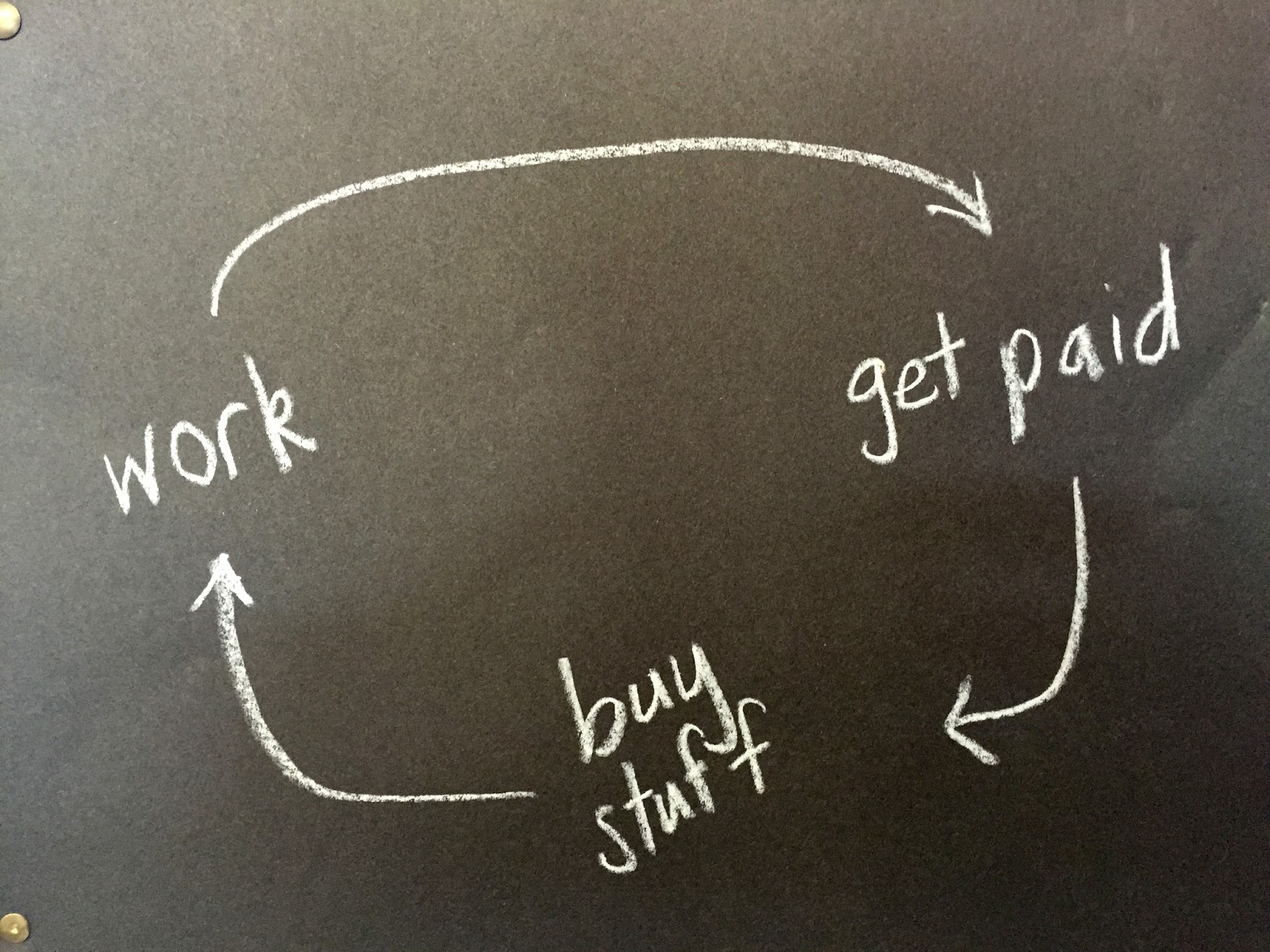
Mr K then shared with us this simple diagram:


We all understood this. This is how the consumer system basically works, isn't it? You work, get paid, then buy stuff. Work, get paid, buy stuff. And it goes on.

But how does this affect our natural environment?

We were introduced to a new thinking routine called 'Chalk Talk'. In this routine, students are in groups of 3-5, gathered around a sheet of paper. They are given an idea or a question to discuss. Only this is not a verbal discussion. Students need to convey their ideas by writing or drawing diagrams and images. Any responses to what others say, need to be in written form. The outcome here is that we have our thinking represented visually. It allows for students to have no interruptions, while giving those who are often reluctant to share their ideas with a large group the confidence to have their voice heard.

Our question was:
What effects does this system (diagram above) have on the environment?


Our responses generated a lot of interesting ideas for discussion. Most groups mentioned the cutting down of trees for wood and paper products and how deforestation is an environmental issue. Phoebe's thoughts about plastics, most notably that oil is needed to make it, really fuelled conversation. We talked about the distance in which many of the things we buy travel before they even get to us, and what happens when we are finished with them.

Mr K used the coffee he bought before school as an example. He walked into his local coffee shop in the morning for a cup, that was made of printed cardboard with a plastic lid, filled with coffee, sugar and milk. He handed over $5.00, consumed the coffee, then put the cup in the bin. Is that the end of the cycle? We suspected that it probably wasn't. Once our red bin is collected by the City Council, most children knew where the contents ends up.

We then used a personal example - A meal from McDonalds. This led to a very lively discussion about the whole chain of events that happens before we hand over the money for one of those.

So what? We wondered how this system can be improved. At this stage, we aren't quite sure. But we do know that with food, the best way to make the system environmentally friendly is to produce your own.

Room 14's new challenge is to work out how we can grow vegetables in our classroom. We will be using recycled materials to design and build containers or structures that can house our produce. We will also be investigating how plants even grow (!) and how we can maintain them, while making links to other learning areas, like measurement and statistics, where possible. A number of us have already been generating ideas about how this will link with our explanation and persuasive writing focus too.

Today we watched Jamie Oliver's TED Talk about how we should teach every child about food, which was really the icing on the cake (maybe not the best pun) as to why we should be learning about how to grow our own vegetables and how this may benefit us in the future.


Our next step is to decide how we will group ourselves, where we will find information and materials, and how we will design these systems.

Here are our responses to the Chalk Talk routine:


Friday, 19 June 2015

Assembly Video: Interest Projects

Thank you to everyone who came to our assembly this morning. We enjoyed sharing our learning with you.


Here is the video we shared about our I.P. journey so far. We are looking forward to seeing where these projects lead us.

Saturday, 6 June 2015

Human Migration Board Games

Linking with our migration theme, we have been looking to become 'learning leaders' by teaching others about what we have learned so far this term.

We are currently creating our own board games that teach players a little about how human migration is a response to challenges, risks and opportunities. 

If you have been following our Twitter you will have noticed some tweets about this project over the last couple of weeks. 

It began by us asking - 'What makes a good board game?'


We came up with our own criteria for board games:
  1. Good length
  2. Quality - Artwork and pieces
  3. Challenging - But not too hard
  4. Fair
  5. FUN (not a 'bored' game!)

We started to design our own games. We found inspiration in the stories of human migration that we have investigated recently. Push and pull factors are used as the positive and negative effects on the players in our games, which are mostly about players trying to get themselves from one place to another.

Linking with our explanation writing focus, we have also been looking at instruction manuals for well-known board games, identifying common sections, and writing our own game instructions using appropriate vocabulary. These have been created in Google Docs and shared with Mr K for printing and laminating. 

Testing our games has proven to be so important, as others have helped us to identify flaws in our games. Most of us have found areas for improvement before we begin our final creations. 


This week we have begun on our final products. Still works in progress, but we are looking forward to inviting the rest of our senior syndicate to play our games and give us feedback. 


It is exciting to see so many board game themes arising from the literacy projects we have been involved in, from the story of Canterbury's First Four Ships, to tales of Polynesian discovery in the Pacific. The links we have made to our Geometry focus is also important, as many of the games involve the use of compass directions for navigation. This is a project that has allowed for a number of learning areas to be integrated. We are currently thinking about whether we should create commercials for our games on our iPads to 'pull in' prospective players from outside of our classroom...

Sunday, 31 May 2015

IP's In Room 14

Over the past week we have begun planning some individual interest projects in Room 14 (IPs - not to be confused with Internet Providers!). 

The reason for these projects is to give us time each week to spend developing our independent inquiry skills working on projects that are of special interest to us. This is our take on some education initiatives that are becoming popular in many schools, like 20Time and Genius Hour. Click on the links if you are interested in reading more. 

All of us have completed a basic overview of our intended interest project, including 2 or 3 driving research questions, the resources we will require, and our current thoughts on how we may share our learning. 

Throughout our IP journey, we are required to:
1. Create a plan and communicate our intended learning direction (completed).
2. Keep others informed about our progress (Which we are all doing via an IP blog. Some of us are using our existing USpace blogs, but most of the class have decided to set up a new Blogger blog specifically for our IPs).
3. Share our learning with the class (This may come in many forms). 

Nearly all of our IPs have links to our Looking Back to Look Forward theme, so many of us will be making links to the learning we have already been engaged in this term.

Our next steps are to develop timetables for allocating time to our IPs during the week in class and to begin gathering our required resources. We will also add our IP blog links to this blog, so you may like to read about our individual learning journeys as they unfold. 

All of our IP plans are on display in the classroom. Friends and family feel
free to come and have a look. We will begin personalising each of our spaces
on the wall - adding information about how others can find out more about
our individual IPs.


Setting up our new IP blogs on Blogger was exciting for many of us.
We look forward to sharing them.


Thursday, 14 May 2015

Human Migration Projects

It was a satisfying day for many of us today, as we had the opportunity to share some of the literacy projects we have been working on that link with our migration inquiry.

Underneath our big idea - "Human migration is a response to challenges, risks and opportunities", we have been following on from our initial investigations into the causes of human migration, to look into real examples, specifically in the Pacific. 

The push and pull factors that brought our ancestors to Aotearoa


Our groups have been working on quite different projects. The Daredevils read about Maori sailing by starlight, so they wrote poetry about Maori exploring. They also created artwork to go with their poetry in a similar style to our Anzac art. 

The Daredevils' Maori exploration art


The Iron Men used Google Slides to work on a collaborative presentation where the boys each answered different questions about Polynesian discovery and the spread of various Polynesian cultures.


Both the Flashes and the Wonderwomen were retelling real stories that involved early settlement of New Zealand and the surrounding islands. 

Our sharing session today was a great way to reflect on our learning. For those retelling real stories, several of us had factual inaccuracies pointed out to us that we had included in our presentations. We will be revisiting how these happened in our groups. One of our next steps in researching as a class is to work on our referencing and sharing our sources of information (an area we really need to develop). 

Here are some snippets of today. Not only did the presenters do a great job, the audience did so well to listen carefully and to provide thoughtful feedback. Most of us have uploaded our projects to our digital portfolios.


The majority of the class chose Jacob's Explain Everything video as their standout presentation of the day, so here it is (Note: He is aware he muddled up a couple of facts!):


We will soon be learning about the effects that migration has both on people, and on places. Keep an eye on our Twitter and blog.