We recently had our cluster technology challenge. Our class and Room 5 at Bamford School took part.
The idea was that we would be undertaking the same challenges from our own schools, but would key an eye out (digitally) about how the other teams were doing.
The first challenge was to build a free-standing tower using certain materials that could raise a flag.
The second challenge was a paper planes contest. Students could enter both a 'flight distance' and a 'flight time' competition.
These activities linked well with our Forces and Motion theme, so children were able to use some of the language and scientific terms we have been learning about.
Thanks to Wayne for coming along, giving a hand and showing us your own paper plane designs.
Check out the Linwood Connected Kids blog for some of our reflections and more info.
Thanks to Room 7 for sharing this video in assembly today.
The idea was adapted from a video we viewed earlier in the week. We looked to take inspiration from it and show what everyday caring might look like in our school. Well done to the actors for creating the storyboards for their own scenes. A team effort.
This week we have begun our Forces and Motion unit of inquiry. Gravity and friction are the key ideas we have been investigating, and have been the focus of two hands-on technology challenges in our classroom.
In the first challenge we were required to make a ramp to certain specifications. We then predicted how far a marble would roll along the ground when let go from the top of the ramp.
After measuring the actual distance rolled and comparing with our estimates, we had some great discussions around our understanding of gravity and friction. It was most interesting hearing what everyone thought was in the centre of the Earth. Answers included "special stones", "rocks" and "black stuff". Some ideas there for further investigation.
The second challenge features in the video below.
As predicted by some of us, it certainly was a challenge working in groups of 4 or 5. Many people often have different ideas on what will work best in situations like this, so the designated 'team managers' had a busy job.
We agreed that some of the construction work wasn't pretty. But it was good to see everyone searching hard for materials that could serve a purpose (you may have noticed all of the random maths equipment and stationery items being used!).
A couple of groups managed to complete the task and others came very close. The most common challenge was the marble losing too much speed by crashing into walls. All groups realised that they needed to do what they could to maintain the marble's speed (provided by gravity), while keeping it on track to cross each piece of masking tape.
We will be reflecting on what we noticed during this challenge, while exploring more of the physical world around us over the coming weeks.
At this stage, the blog is a partnership between three Year 5/6 classes, one from Bamford School, one from Linwood Ave School, and us!
The idea behind this is for our students to be posting content they have created and giving and receiving feedback on their own and others’ learning. There will also be some literacy challenges posted by teachers for children from all 3 schools to be engaged in.
We look forward to seeing how this pans out, as we can see a lot of potential there for development with the inclusion of more schools and classes. Let us know what you think!
This term we have read, heard and viewed a lot of interesting stories and documentaries about our basic consumer cycle. By this, we mean the 'work, get paid, buy stuff' cycle we blogged about several weeks ago.
The more we have learned, the more we have come to accept that we all play an active part in this system, and in many ways we are dependent on it. As kids, we have fewer choices than adults, but we know that one day we will be the leaders in our communities and will have more of an influence over the people and places we interact with.
Last week we watched a documentary called The Story of Stuff. It explains how our materials economy works and the negative impacts it has on our planet right through the system, from the extraction of raw materials from the Earth, to when we dispose of the products consumed.
We have learned a lot about note taking. Through taking both written and visual notes, we have been able to pull out what we believe are the most important pieces of information from the videos/texts we have been using to gain a broader understanding of this topic. Some of the notes taken about The Story of Stuff truly were hives of information that we could call upon later. We have examples on display in our classroom.
Many of us have been talking about how we need to change the way we live in order for us to have a more sustainable future. But would anyone listen to us? Aren't kids too young to know what's best? We watched a TED Talk by Adora Svitak called 'What adults can learn from kids'. The consensus we made from this is that kids do come up with great ideas. If we are to be adults one day, surely we should have a voice about the world that is waiting for us.
This week Mr K put a question our TV - 'What needs to change?'. It was great to see the responses. Through our statements, we can see a deep understanding of this topic being developed and how far we have come from the first Chalk Talk routine. From Jacob's quote about how if consumers stop buying certain things, companies that negatively affect our environment will go out of business, to Jen's statement about how Boxing Day sales and other huge consumer 'field days' can be chaotic and leave people possibly feeling like they need to buy lots of things they don't really need.
(We have put our names to our individual quotes on our classroom walls)
So where to now? Well, we have all decided on one of three project ideas to pursue...
1. Create and present detailed explanations about how our materials economy works
2. Create and present a TED Talk of our own, sharing some of the ideas we have to fix the consumer system.
3. Create visual displays that carry strong messages from us about how we can make positive changes to our school environment.
The animations/screen-casting group have begun learning about storyboarding, with some already drafting their creations on large displays.
The TED Talks group have started investigating what makes a good speech, as well as how using Google Slides for a presentation allows them to read their own speaker notes while projecting the slide imagery through a screen using Apple TV.
The visual displays groups have been brainstorming things we do at our school that have negative environmental effects.
Over the past two days, we have been discussing a lot about what success will look like for these projects. We are all striving for excellence, which is in our learner licence criteria, and are trying to become 'learning leaders' by shifting the thinking of others. We look forward to sharing our presentations with you.
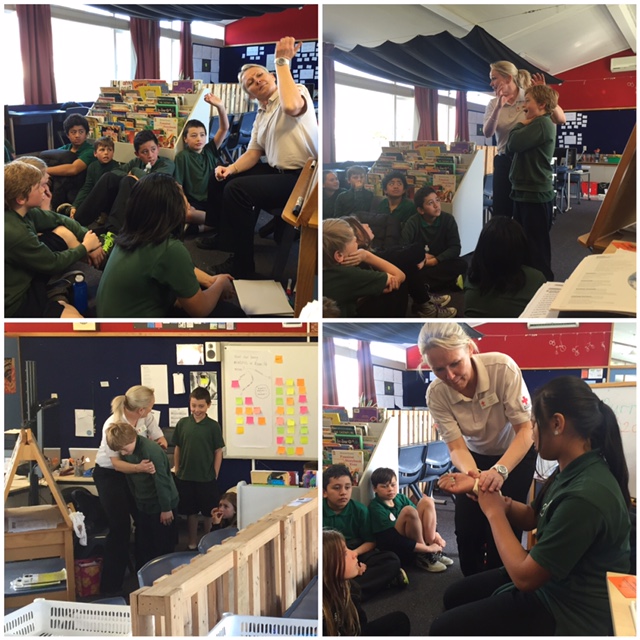
Today we were lucky enough to have Stacey from the Red Cross spend the day in Room 14 teaching us about first aid.
We learned about what we should do when confronted with a range of emergency situations. These included things like shock, nosebleeds, broken bones, burns, poisons, and seizures to name a few.
When we are with someone who is in need of medical treatment, we now know about DRSABC, which stand for a recommended process we should follow.
D = Danger (check for dangers)
R = Response (check the person to see if they are conscious)
S = Send for help
A = Airway (check if the person's airways are clear)
B = Breathing (check if the person is breathing)
C = Circulation (check for bleeding)
We enjoyed taking part in role play activities this afternoon, where we acted out some emergency scenarios in groups. Stacey gave us constructive feedback on how we performed.
Thank you to Stacey for running the programme. All of us will no doubt encounter emergency situations in our lives, so it is great that we now have a foundation set of first aid skills to build on.
Before school this morning, two of our early arrivers, Phoebe and Reuben, went with Mr K to take some photographs of the car wreckers yard behind our school.
When school began we started by discussing 'sustainability' as a class. We also added two new words to our vocabulary - 'renewable' and 'nonrenewable'. We identified examples of things that we use which fell into both of these categories.
Phoebe and Reuben shared their photos and we watched a video about the life cycle of a car. We found that a lot of the reusable parts of a car are recycled. However, we also found out that the leftovers went to landfill (the dump). Apparently, people own 9 cars on average in their lifetimes. We discussed what happens to these after we finish with them, as well as the fuel used to run each car while it is in use. Our conclusion was that petrol-powered cars are not really sustainable.
We made lists of modes of transport that we thought were more sustainable than cars. Many of us came up with decent-sized lists. Some things included skateboards, sail boats, bicycles, rollerblades, electric trains, handcars (thanks Jacob) and walking.
When asked which of these things could be used more by a large number of people, through a voting system we thought that bicycles were the smartest choice. But would the community be willing to use bicycles more? We found this video about how people are reusing bicycles in Havana.
Next, we were split into groups for a circle of viewpoints routine. Each group was asked to discuss how they felt about the possibility of new laws being introduced that meant more bicycles and less cars on the road. Our thoughts were displayed on the wall.
The groups were:
Car salespeople who sell new vehicles
Adults who drive cars and use them everyday
People who work in car wreckers yards
Us (children)
Now it was role-play time. Mr K announced that he was the mayor and would like to hold a town meeting. We went out to the netball courts, mixed ourselves up so we weren't beside all of the people who we had been working with and gathered together.
The mayor said that he was thinking of creating some new laws and wanted the community's opinions. A microphone was passed around when someone had something to say. We mentioned some of the points we wrote down in our groups beforehand and also responded to what others were saying. This was a lot of fun because many of us had created make-believe identities and put on different voices!
After the meeting we got together (as ourselves) and discussed the arguments people put forward, while also putting the spotlight on those who we thought were great contributors to the activity. Quaylen's performance, as Professor Jones from Lincoln who didn't want to bike for two hours to work, was a highlight for many.
The next stage was to do some shared writing with a buddy, on a Google Docs template, about whether we think more should be done to increase the number of bicycle users, while decreasing the number of cars on the road.
We will soon be sharing our writing with the class. The pieces that we believe are fantastic examples will be on display in our classroom.
We have also started designing our own modern bicycles and making models of them with construction wire. Although, this is proving a lot harder than we imagined! Keep an eye on Twitter for updates.
Due to us having all of our Year 6s at Cycle Safe this week, our Year 5s in Room 14 have had a chance to spend some time together exploring something we think is really cool.
Earlier in the week we solved this problem, as we were revisiting some of the concepts we have been learning about through our geometry focus this term. Stella make some connections and told us about her experiences Geocaching, which is an activity that involves an item, or a container holding a number of items, hidden at a particular location for GPS users to find by means of coordinates posted on the Internet. It turns out that the activity of Geocaching involves using a lot of the mapping knowledge and skills we have been looking to develop recently.
Stella told us that her grandad, Rodney, is a keen Geocacher, so we asked if he would like to come in and tell us a little more about it this morning.
Rodney explained to us how GPS works, how Geocaching works, and he even shared a few of his personal experiences of Geocaching. Can you believe he has found nearly 7000 items since he began hunting in 2002?
If you are wondering how many there are hidden in Christchurch, just take a look at this map.
Here is a video of our hunting through Cypress Gardens today. We used iPads, compasses and our appetites for adventure to help us in our search.
Thanks again to Rodney for taking the time to come in and speak to us! It sounds like the Geocache website will soon have some new members.
This afternoon we tried something new and exciting. We had an online chat with other Year 5/6 classes from Bromley School, Linwood Ave School and Bamford School.
We worked in groups to answer four questions for the day, which included:
Q1: What are your favourite things about your school and why?
Q2: Do you think your classroom is like most other Year 5/6 classrooms in New Zealand? What makes it the same and what makes it different?
Q3: What positive skills and attitudes do your class care about most?
Q4: Make a sentence or poem using these 3 words: Teamwork - Attitude - Positive
We used Today's Meet, which we have used as a class and blogged about recently. This was a great way to connect with our neighbours and learn more about them. We loved sharing about our classroom and what is special to us about our school.
Check out some photos from the other classes involved. We used the hashtag #linwoodkidschat on Twitter.
We wonder if there are things that we could learn from the children from these local schools in the future. Could we collaborate on projects of interest? What other possibilities are there?
Linking with our migration theme, we have been looking to become 'learning leaders' by teaching others about what we have learned so far this term.
We are currently creating our own board games that teach players a little about how human migration is a response to challenges, risks and opportunities.
If you have been following our Twitter you will have noticed some tweets about this project over the last couple of weeks.
It began by us asking - 'What makes a good board game?'
We came up with our own criteria for board games:
Good length
Quality - Artwork and pieces
Challenging - But not too hard
Fair
FUN (not a 'bored' game!)
We started to design our own games. We found inspiration in the stories of human migration that we have investigated recently. Push and pull factors are used as the positive and negative effects on the players in our games, which are mostly about players trying to get themselves from one place to another.
Linking with our explanation writing focus, we have also been looking at instruction manuals for well-known board games, identifying common sections, and writing our own game instructions using appropriate vocabulary. These have been created in Google Docs and shared with Mr K for printing and laminating.
Testing our games has proven to be so important, as others have helped us to identify flaws in our games. Most of us have found areas for improvement before we begin our final creations.
This week we have begun on our final products. Still works in progress, but we are looking forward to inviting the rest of our senior syndicate to play our games and give us feedback.
It is exciting to see so many board game themes arising from the literacy projects we have been involved in, from the story of Canterbury's First Four Ships, to tales of Polynesian discovery in the Pacific. The links we have made to our Geometry focus is also important, as many of the games involve the use of compass directions for navigation. This is a project that has allowed for a number of learning areas to be integrated. We are currently thinking about whether we should create commercials for our games on our iPads to 'pull in' prospective players from outside of our classroom...
A few weeks ago we posted about how home learning had been a big topic of discussion in Room 14.
We continued to ask why we have home learning, and in particular - Which activities are more beneficial to our learning than others? Mr K agreed that he would not set any tasks purely for the sake of giving homework and is aware of the many activities that some students are involved in outside of school.
We decided that the best use of our home learning time would be for such things as:
Preparing us for upcoming learning activities in class
Practising basic facts and other maths concepts
Word study / Language activities linking to a current focus
Discussions with our friends or family about a current topic of interest to us
Preparing for our Friday Readers' Café
Speaking of Readers' Café, we should blog about this soon and share how this is looking in 2015. As a result of our home learning discussions, we now need to have a parent initial as evidence that we have been reading a particular text at home and in turn have entry to our Readers' Café on Friday mornings.
Our 3-Way Conferences were a great forum to discuss home learning. All parents supported home learning in some form. Their main reasons included developing study skills, practising concepts taught at school, and having family involved in their child's learning. For a number of us, having our teacher and parents together was a good time to create some agreements and shared expectations.
Since our last post we have had over 90% of us completing our home learning each week. Can we keep this up?
Thank you to all of the parents who came along to our 3-way conferences over the last two days.
It was a great chance for us to share with you our learning highlights and challenges from 2015 so far.
Many of us have created new learning goals with input from our parents. We look forward to celebrating our progress from this checkpoint when we meet again later in the year.
Well done to all Room 14 children for preparing your portfolios and planning your conferences. The meeting time always seems to go so fast, so parents please feel free to come in to the classroom between 8.30am and 8.55am (our Organisation Time) during the week for your child to share more of their learning with you. Much of our digital learning is also accessible online.
We spent three days challenging ourselves, developing new skills, working together and creating great experiences we may never forget.
This week we will be putting together a collaborative camp journal and reflecting on our experiences for our portfolios ahead of our 3-way conferences in Week 4.
We would like to say a special thanks to our Room 14 parents, Bryan, Shane and Tobi, who accompanied us.
Our weekly Readers' Café is an important part of our classroom programme. It has developed over three years (initially being an extra guided reading group for low ability readers) to something that we see as beneficial to all learners.
We get together in our literacy groups every Friday morning to share the personal reading we have been enjoying.
Here's a recent snippet...
We are constantly getting feedback from each other about Readers' Café. Where might we go next?
We've been meaning to post a bit of the footage from our community clothing sale at the end of last term. Thank you to everyone who donated. A portion of the profits have been given to each of the senior school classes for enhancing their physical environment in some way.
All Room 14 children contributed their ideas on a wiki page we created online. After much discussion in class, the money we received was used to buy some lanterns and new book storage units.
On crazy hair day we spent time sharing the information reports we had written about a job that interests us with our literacy group. In writing our reports, we followed our self-edit, peer-edit and teacher conference system before publishing. Many of us chose different ways of sharing our writing, from using Book Creator, Keynote, iMovie, Explain Everything and Pages on the iPads, to handwritten books and posters.
After sharing with our literacy groups, we let them critique our writing and had their input into how we could assess ourselves using our group marking rubric, which we created before writing. Group members were able to vote on each criteria by using a simple 'poor, 'O.K' or 'excellent' scale.
We learned that an information report has to contain appropriate language and structure, while also being clear enough for others to read and understand.
These play an important part in developing a culture of learning in our classroom. They allow us to identify learning role models, as well as giving us a clear vision of what great learners do.
Learner licences are not necessarily for 'high-achieving' children. They recognise those who always display a love of learning and attitudes that we truly value. Their peers have identified them as having these characteristics. An achievement to take great pride in.
With our cricket team away and various other activities happening on Friday afternoon, a small group of us undertook a technology challenge.
The focus for this was around teamwork. Before we started, we discussed questions like, "What happens if you have different ideas to your peers?", "How do I get people to listen to my ideas?" and "What is the difference between showing leadership and being bossy?"
Although we would have liked more time to work on our designs (as the time limit was a bit short), we thought we worked well in our teams, as you can see in some footage of the task. Excuse the sound of workmen and their chainsaws cutting back some trees in the background...
We often speak about the characteristics of great learners. Especially as we evaluate and reflect on each week, recording our weekly highlights and challenges, as well as determining how well we managed our learning on a self-management scale. But what are we working towards? Do we really know the skills and attitudes we require to be great learners? This activity gave us a clearer perspective on the traits we collectively value.
First, we had a think-pair-share about the positive traits we believe great learners have. After sharing our ideas, we looked back on our blog to see what Room 14's class of 2013 said in a similar activity. Then we each wrote down 3 of the traits that we thought were most valuable to a learner and put our lists in a box.
Here is a word cloud showing the results. Traits appear larger the more times they were written in the box...
This graphic will be on display in our classroom and will help with our weekly goal setting and evaluations.