Showing posts with label My voice is powerful. Show all posts

Sunday, 13 December 2015

Interest Projects - All Wrapped Up For Christmas

It has been so satisfying for many of us sharing our term four interest projects.

One way we ensure that we are taking ownership, accountability and responsibility for our learning in Room 14 is through the sharing routines we have. During our first I.P. this year, sharing in front of the class seemed a little daunting for some. However, the encouragement shown for each other and the ability to give constructive feedback has grown to such a level that sharing interest projects is a positive experience and a time for celebration. The conversation arising after the sharing of an interest project is genuinely exciting as students often realise that they are the most knowledgeable person in the room about their chosen topic, which can be so empowering when answering questions from their peers.

Those who initially found driving their own projects a challenge have made great progress. Being handed more responsibility and knowing that the teacher is only assisting as a guide was something to get their heads around at first. Of course, there are still things that all of us could have improved on this time, but our skills and attitudes for self-driven inquiry projects have grown a lot as a class.

We had a 'How Stuff Works' theme of sorts this time. It was wonderful seeing how deep some students could get into their questions and how they could communicate some very technical, jargon-filled scientific explanations in a way that we could all understand. Jacob's 'How do batteries work?', Kerryn's 'How does lightning work?' and Izyah's 'How do earphones work?' projects were nice examples of this.


Before putting together our presentations, we co-created a sharing rubric together that included what we thought would make a great presentation, as well as a couple of aspects of our last I.P. sharing days that we needed to work on. We assessed ourselves after receiving feedback from our peers and Mr K. See the completed rubrics in our digital portfolios.


Next year we will look at how the I.P. format could fit in with our learning programmes. For our Year 6s that are leaving us, we hope that these interest projects have given them a chance to further develop their 21st century learning skills and attitudes, which we hope they can utilise wherever they are heading.

Sunday, 18 October 2015

Linwood Connected Kids Blog

Check out this new blog that we are a part of... 


At this stage, the blog is a partnership between three Year 5/6 classes, one from Bamford School, one from Linwood Ave School, and us!

The idea behind this is for our students to be posting content they have created and giving and receiving feedback on their own and others’ learning. There will also be some literacy challenges posted by teachers for children from all 3 schools to be engaged in. 

We look forward to seeing how this pans out, as we can see a lot of potential there for development with the inclusion of more schools and classes. Let us know what you think!

Keeping Our Vision In Focus And Responsive Goal Setting


Term 4 always seems to fly by so fast. Sometimes we forget to step back and think about how we are going and to reflect on our progress.

Last week we spent time discussing many of our successes this year as a class. Our units of inquiry were mentioned, and many of us thought that overall we have a very positive learning environment (which was part of the vision we created for 2015 back in Term 1, to "Contribute to a positive learning environment").

In fact, we spent several weeks at the beginning of the year outlining what kind of learning environment we wanted, along with what we expected of ourselves and others. The question we have been asking this week is - 'How can we keep our vision in focus?'

We really want to end the year on a high. Last week was about identifying those goals that keep popping up in our individual planners, which we have not yet mastered. This is responsive goal setting. Two aspects of our vision are that we "Strive for excellence" and we "Own our learning". Along with identifying key skills and attitudes as goals for this term, we have been taking ownership of them, asking what mastery will look like and knowing the point at which they will be achieved.

We can't wait to achieve these ones.


Thursday, 1 October 2015

Consumerism - Sharing Our Thoughts and Ideas


We have had a busy last couple of weeks preparing to share our individual learning about our Consumerism theme. These are the projects that were outlined in this previous post.

One of the challenges we faced when having our own Interest Projects in Term 2 was managing our time. So, when we were given the presentation date for our Consumerism projects, Mr K also shared an individual timeline with each of us via Google Docs. We had to complete an outline of how we would be using our independent learning time at school in order to be ready to present on the sharing day. In a sense, we had to 'plan backwards', having an end product in mind, then deciding what steps were needed to get there and how much time would be required to complete each of these steps.

We developed project assessment rubrics for each of the project mediums we chose (animation/screen-casting, TED style speech, or posters). These rubrics were also shared with us via Google Drive, where Mr K wrote his feedback on our projects while we were sharing to the class, and we completed a self-reflection section on the same document after. Over the coming weeks, we will be adding footage of ourselves sharing and/or other images from our presentations. This could be a very effective way for teachers and students to co-construct learning documentation going forward.

It was great to see the differences in the projects that were shared. The animations all had a different 'feel' to them and a range of filming methods were used. The TED-style talks were very successful as many children surprised us at how confident they could be in front of an audience. It was also exciting to see these students giving each other constructive feedback and researching presenting tips as part of their journey. They really thought about what an effective talk would look and sound like. The group that were creating posters carrying environmental messages had less time available to them (as they were also in our gardening group), but still communicated some thoughtful ideas.


We hear the word 'self-manage' used a lot, but we know that everything that is involved in that (managing our time, resources, decisions, emotions, etc) takes ongoing development and practice. As evident in our most recent projects, it has been great to see the progress of individuals and the honest reflections everyone has made about successes, challenges, and the cause and effects of these.

Here are a few snippets from some presentations. See our individual portfolios and media galleries for more footage.


Wednesday, 9 September 2015

Consumerism - What Needs To Change?

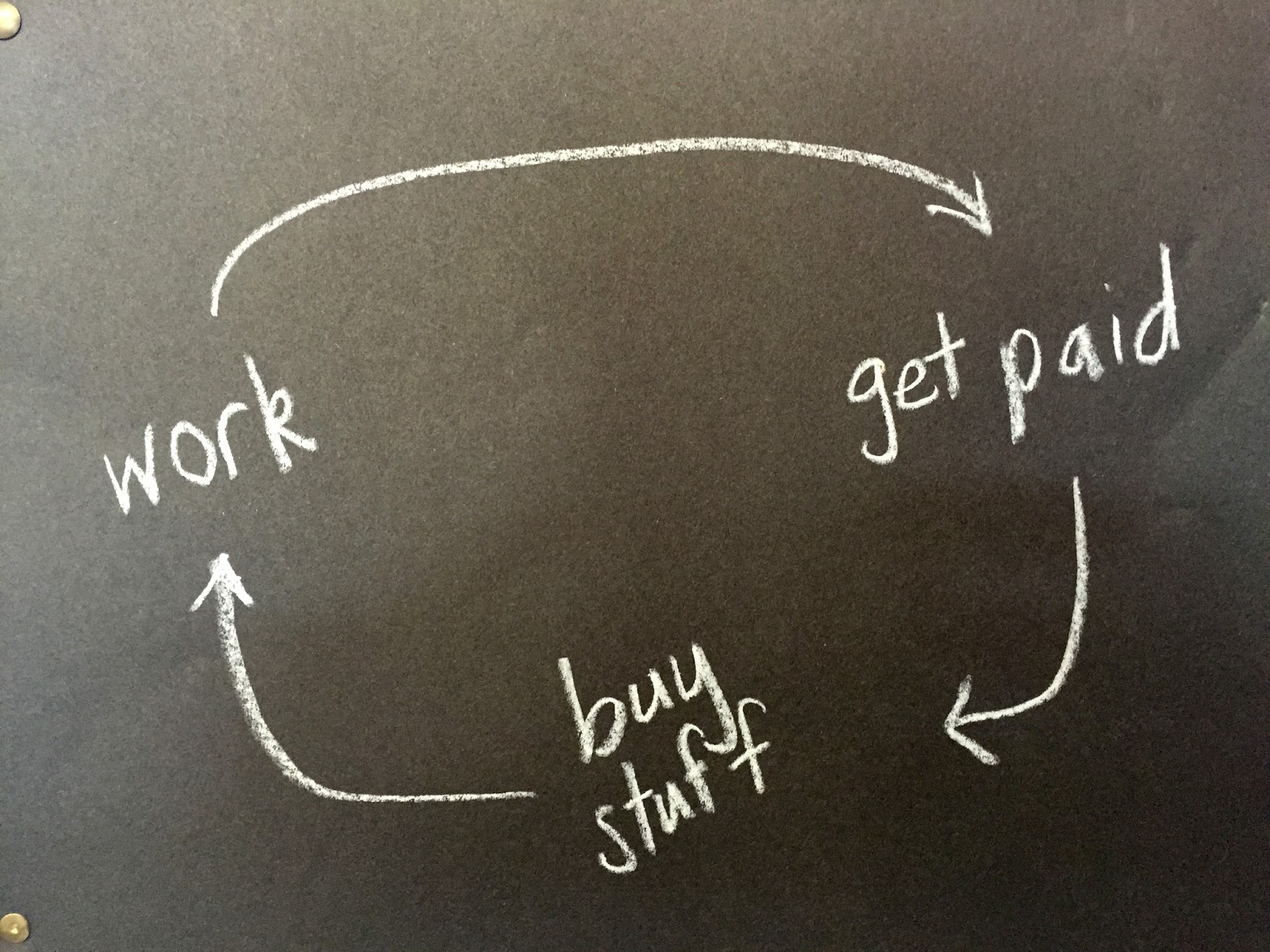
This term we have read, heard and viewed a lot of interesting stories and documentaries about our basic consumer cycle. By this, we mean the 'work, get paid, buy stuff' cycle we blogged about several weeks ago.

The more we have learned, the more we have come to accept that we all play an active part in this system, and in many ways we are dependent on it. As kids, we have fewer choices than adults, but we know that one day we will be the leaders in our communities and will have more of an influence over the people and places we interact with.

Last week we watched a documentary called The Story of Stuff. It explains how our materials economy works and the negative impacts it has on our planet right through the system, from the extraction of raw materials from the Earth, to when we dispose of the products consumed.

We have learned a lot about note taking. Through taking both written and visual notes, we have been able to pull out what we believe are the most important pieces of information from the videos/texts we have been using to gain a broader understanding of this topic. Some of the notes taken about The Story of Stuff truly were hives of information that we could call upon later. We have examples on display in our classroom.


Many of us have been talking about how we need to change the way we live in order for us to have a more sustainable future. But would anyone listen to us? Aren't kids too young to know what's best? We watched a TED Talk by Adora Svitak called 'What adults can learn from kids'. The consensus we made from this is that kids do come up with great ideas. If we are to be adults one day, surely we should have a voice about the world that is waiting for us.

This week Mr K put a question our TV - 'What needs to change?'. It was great to see the responses. Through our statements, we can see a deep understanding of this topic being developed and how far we have come from the first Chalk Talk routine. From Jacob's quote about how if consumers stop buying certain things, companies that negatively affect our environment will go out of business, to Jen's statement about how Boxing Day sales and other huge consumer 'field days' can be chaotic and leave people possibly feeling like they need to buy lots of things they don't really need.


(We have put our names to our individual quotes on our classroom walls)

So where to now? Well, we have all decided on one of three project ideas to pursue...

1. Create and present detailed explanations about how our materials economy works
2. Create and present a TED Talk of our own, sharing some of the ideas we have to fix the consumer system.
3. Create visual displays that carry strong messages from us about how we can make positive changes to our school environment.


The animations/screen-casting group have begun learning about storyboarding, with some already drafting their creations on large displays.

The TED Talks group have started investigating what makes a good speech, as well as how using Google Slides for a presentation allows them to read their own speaker notes while projecting the slide imagery through a screen using Apple TV.

The visual displays groups have been brainstorming things we do at our school that have negative environmental effects.

Over the past two days, we have been discussing a lot about what success will look like for these projects. We are all striving for excellence, which is in our learner licence criteria, and are trying to become 'learning leaders' by shifting the thinking of others. We look forward to sharing our presentations with you.

Wednesday, 5 August 2015

More Bikes, Less Cars: What Would The People Say?

Before school this morning, two of our early arrivers, Phoebe and Reuben, went with Mr K to take some photographs of the car wreckers yard behind our school.


When school began we started by discussing 'sustainability' as a class. We also added two new words to our vocabulary - 'renewable' and 'nonrenewable'. We identified examples of things that we use which fell into both of these categories.


Phoebe and Reuben shared their photos and we watched a video about the life cycle of a car. We found that a lot of the reusable parts of a car are recycled. However, we also found out that the leftovers went to landfill (the dump). Apparently, people own 9 cars on average in their lifetimes. We discussed what happens to these after we finish with them, as well as the fuel used to run each car while it is in use. Our conclusion was that petrol-powered cars are not really sustainable.

We made lists of modes of transport that we thought were more sustainable than cars. Many of us came up with decent-sized lists. Some things included skateboards, sail boats, bicycles, rollerblades, electric trains, handcars (thanks Jacob) and walking.

When asked which of these things could be used more by a large number of people, through a voting system we thought that bicycles were the smartest choice. But would the community be willing to use bicycles more? We found this video about how people are reusing bicycles in Havana.


Next, we were split into groups for a circle of viewpoints routine. Each group was asked to discuss how they felt about the possibility of new laws being introduced that meant more bicycles and less cars on the road. Our thoughts were displayed on the wall.

The groups were:

  • Car salespeople who sell new vehicles
  • Adults who drive cars and use them everyday
  • People who work in car wreckers yards
  • Us (children)


Now it was role-play time. Mr K announced that he was the mayor and would like to hold a town meeting. We went out to the netball courts, mixed ourselves up so we weren't beside all of the people who we had been working with and gathered together. 


The mayor said that he was thinking of creating some new laws and wanted the community's opinions. A microphone was passed around when someone had something to say. We mentioned some of the points we wrote down in our groups beforehand and also responded to what others were saying. This was a lot of fun because many of us had created make-believe identities and put on different voices!


After the meeting we got together (as ourselves) and discussed the arguments people put forward, while also putting the spotlight on those who we thought were great contributors to the activity. Quaylen's performance, as Professor Jones from Lincoln who didn't want to bike for two hours to work, was a highlight for many. 

The next stage was to do some shared writing with a buddy, on a Google Docs template, about whether we think more should be done to increase the number of bicycle users, while decreasing the number of cars on the road.


We will soon be sharing our writing with the class. The pieces that we believe are fantastic examples will be on display in our classroom. 

We have also started designing our own modern bicycles and making models of them with construction wire. Although, this is proving a lot harder than we imagined! Keep an eye on Twitter for updates. 

Monday, 27 July 2015

Sharing Our Interest Projects

Today was a chance to celebrate the journeys we have each been on for our Interest Projects (I.Ps).

All I.Ps had a 'Past, Present, Future' focus, linking with our Looking Back to Look Forward term 2 theme.

Last week we spent much of our independent learning time preparing what we would share today. For some of us this was a slightly daunting task, as we have realised more and more that we are the ones who own our I.Ps. Although we did follow a simple generic structure, they were created by us, for us, and were to help develop our independent inquiry skills and knowledge of the research process.

Today while sharing we were required to share:

  • Why we chose our I.P.
  • Our big question and our smaller driving questions.
  • What we did and what we learned.
  • Our I.P. highlights and challenges.

We were also required to actively seek feedback from the audience about our learning and process. 


Some of the highlights from today were:
  • We were able to see and hear about what others have been doing. This includes our higher performing students, whose projects could be seen by others as benchmarks for how the journey may look when carried out to a great standard, allowing many of us to identify what we could do better next time. 
  • The majority of us were able to use what we have been learning about in our literacy groups in a new context. Some of these things included note taking, identifying key words relating to our IP topic that we could use in our research, understanding subject-specific vocabulary and creating a glossary of terms, and citing references from a range of sources in our research. 

We will soon be completing I.P. self-evaluations and ensuring that our learning is evident in our digital portfolios. Remember to check out the blogs we created for these projects, which are listed on a subpage at the top of this blog.

We may undertake new I.Ps in term 4, but we will see how our other inquiries unravel.

Wednesday, 22 July 2015

Chalk Talk, The Environment And Buying 'Stuff'

This week we have been looking at a number of provocations around our Term 3 theme, 'Consumerism'. Early discussions, thoughts and ideas have been meaningful and will seemingly set us up for some powerful lines of inquiry this term.

We began by defining what we mean by "the environment". For those of you who know a little about our Room 14 values and vision, the term 'learning environment' is a common part of our vocabulary. But this is not what we mean by 'the environment' in this new context, so we needed to clarify that this was considering the natural world and all that exists in it.

Mr K then shared with us this simple diagram:


We all understood this. This is how the consumer system basically works, isn't it? You work, get paid, then buy stuff. Work, get paid, buy stuff. And it goes on.

But how does this affect our natural environment?

We were introduced to a new thinking routine called 'Chalk Talk'. In this routine, students are in groups of 3-5, gathered around a sheet of paper. They are given an idea or a question to discuss. Only this is not a verbal discussion. Students need to convey their ideas by writing or drawing diagrams and images. Any responses to what others say, need to be in written form. The outcome here is that we have our thinking represented visually. It allows for students to have no interruptions, while giving those who are often reluctant to share their ideas with a large group the confidence to have their voice heard.

Our question was:
What effects does this system (diagram above) have on the environment?


Our responses generated a lot of interesting ideas for discussion. Most groups mentioned the cutting down of trees for wood and paper products and how deforestation is an environmental issue. Phoebe's thoughts about plastics, most notably that oil is needed to make it, really fuelled conversation. We talked about the distance in which many of the things we buy travel before they even get to us, and what happens when we are finished with them.

Mr K used the coffee he bought before school as an example. He walked into his local coffee shop in the morning for a cup, that was made of printed cardboard with a plastic lid, filled with coffee, sugar and milk. He handed over $5.00, consumed the coffee, then put the cup in the bin. Is that the end of the cycle? We suspected that it probably wasn't. Once our red bin is collected by the City Council, most children knew where the contents ends up.

We then used a personal example - A meal from McDonalds. This led to a very lively discussion about the whole chain of events that happens before we hand over the money for one of those.

So what? We wondered how this system can be improved. At this stage, we aren't quite sure. But we do know that with food, the best way to make the system environmentally friendly is to produce your own.

Room 14's new challenge is to work out how we can grow vegetables in our classroom. We will be using recycled materials to design and build containers or structures that can house our produce. We will also be investigating how plants even grow (!) and how we can maintain them, while making links to other learning areas, like measurement and statistics, where possible. A number of us have already been generating ideas about how this will link with our explanation and persuasive writing focus too.

Today we watched Jamie Oliver's TED Talk about how we should teach every child about food, which was really the icing on the cake (maybe not the best pun) as to why we should be learning about how to grow our own vegetables and how this may benefit us in the future.


Our next step is to decide how we will group ourselves, where we will find information and materials, and how we will design these systems.

Here are our responses to the Chalk Talk routine: